Showing posts with label Sundays with Steve. Show all posts

Thursday, November 27, 2014

Thanksgiving with Steve

These Sunday's segments are written by my husband, Mr. Jenny. Here's what he has to say about his posts:

I’ve been writing these weekly stories about life in Northern Idaho, as a youngster and as growing into a young man, primarily for our family. And I'm delighted to share them with you. Just between us, I’m anticipating being cranky when some whipper-snapper who may not even be born yet harasses me in 30 years or so with 'Grandpa, tell me about when you were a boy.' That will probably be after the mad cow disease has set in and erased whatever memory is left. So these are the not-so-dramatic adventures of a Baby Boomer in the 1950s, 60s and 70s.  This was first published in about November, 2009.

Thanksgiving

Another Thanksgiving in the books this week, a smaller crowd than usual, and my annual BBQ turkey came in perfectly.  Jenny's traditional perfect, oven-roasted boring turkey was cooked up in plenty of time for the main meal as well.

Boring perfect turkeys reminds me of my Aunt Eugenia, and of all of those Thanksgiving’s in the 1950’s and 1960’s at her house in our small town in Northern Idaho.

Every year, without exception, every single time, Aunt Eugenia massacred the turkey. She over-cooked it to the dryness and consistency of leather. Year after year the white meat was inedible; the juicy dark meat was not. It was obvious to everyone except her that she was secretly trying to make turkey jerky. In later years she laughed at her inability to cook a bird, but in the 1950’s, she was in fierce competition with her sister – my mother – to cook the best turkey. My mother (my father actually cooked it, but I think that was a secret at the time) would prepare the perfectly oven-roasted turkey to transport the short distance to Eugenia’s house for the late afternoon feast. The contrast of the two turkeys was always stunning.


Eugenia would be seem to be embarrassed and fume ever year that her bird was so dry, and that her sister out-cooked her yet again.

Aunt Eugenia (Genie for short) was kind of a strange duck: She was very prim and very proper, always dressed to the hilt, her house always picked-up and tidy, her language impeccable, her presence one of reserved elegance. But underestimate her or cross her at your own peril: Her glare, when you crossed the line of propriety, was like a death ray. Her pronouncements and judgments – out of the public view – were cutting, sharp, and decisive. You never wondered where Aunt Eugenia stood on anything, on any topic, on any view, and woe be to you if you disagreed with her pronouncement. And by the way, you had better shape up and behave yourself in her presence.

Thanksgiving was always at her house, while a month later Christmas dinner always at the Matlock madhouse. Thanksgiving usually consisted of us three rambunctious brothers and our parents, Aunt Eugenia’s two grown children who both still lived with her at the family home (one of whom for many years called us brothers ‘brats’, a term I still don’t like), Eugenia’s mother (my grandmother), and six or eight other adults that included several of Eugenia’s widowed lady friends. Mr. Eugenia had fled life with Eugenia in about 1950.

Eugenia always hired a bit of help for the holiday, usually someone in the kitchen to prepare the side dishes, the desserts, and then to clean-up the kitchen after dinner. For many years the help was a delightful lady named “Coxie”. Ida Cox was entertaining, energetic, and a fountain of local history of our town, most of which she had lived through personally. She stood no more than four-foot eight inches tall, thin as a rail, but with muscular arms. Coxie cooked on a wood burning stove at her small frame home until her death in 1970 at the age of 95. She was a master of home cooking, she delighted in making cakes and pies for her friends and neighbors, and often, if we were lucky, for the Matlock family. She fried chicken on Sundays, after chopping their heads off with a hatchet on Saturdays. She chopped the wood for her stove, and she never believed that gas or electric ovens did a very good job. She would chase us boys around Eugenia’s house when her cooking chores permitted, to the consternation of my aunt, and she befriended all of us brothers for years. She was a delight, one of those characters you never forget.

Eugenia’s son was Eugene (Cousin Gene) who I have referred to in many of these stories as my father’s partner in the local radio station and the radio news broadcaster for our small town.

It was Cousin Gene, my father, and my grandmother “Grambie” who were most vocal about Aunt Eugenia’s annual destruction of the Thanksgiving turkey --- year-after-year. Grambie would have one of her two cocktails a year (the other was always an eggnog before Christmas dinner) while Cousin Gene and my father would dip into the bourbon for a couple of shots before carving the two turkeys that would be resting at the kitchen table. The men would groan over the destroyed turkey as it crumbled under the carving knife, and they may have had another shot of bourbon in honor of Eugenia’s bird. Coxie would cackle and laugh at the poor bird while preparing the stuffing and green beans, and Grambie would sit on a kitchen step stool out of the way, sipping her drink, going “tisk, tisk, tisk” at the pulled pile of white turkey meat. It was really very funny, even to me at that young age. While that was going on, Brother David and I would steal pieces of dark meat to sample. In later years, when home from college for the annual turkey day massacre, Cousin Gene would sneak glasses of bourbon to David and me as well. He was a good cousin that way.


As a curious youngster, I always found it fascinating that there was a little button under the carpet of the dining room table where Eugenia sat at the head. If she needed help from the kitchen, she could press the button with her foot to activate a buzzer. Coxie would ignore her, of course, with a loud laugh, but in later years when Coxie no long cooked for the family, others came running. It was weird.

My mother was no great cook, although she tried. Her salvation at Thanksgiving was two-fold: i) In the late 1950’s Butterball turkeys came on the market that had the plastic temperature probe that popped-up when the bird was done, thus generally preventing over-cooking (Eugenia never figured that one out, one of those new fangled inventions that made no sense to her), and ii) Coxie in the kitchen preparing everything else.

I wish Coxie were alive today -- I’d invite her to dinner and I would fly her from Idaho to Arizona to join us, not to cook but to experience our modern but traditional Thanksgiving and to enjoy our family. I wish my father and Cousin Gene were alive to join us as well, to sneak a bit of bourbon, and to rightly judge whose turkey this year is best.

I wish you were coming too, because I know that you, along with all of our Thanksgiving day guests this year, are going to appreciate the finesse, the delicacy, the suberb nature of the masterfully prepared cherry-wood smoked turkey that will jointly grace our table on Thursday along with its boring counterpart, the perfectly oven-roasted bird.

Friday, November 25, 2011

Early Sundays with Steve - Thanksgiving

This is Steve's Sunday post, but it seemed more relevant to post it today, the day after Thanksgiving.

These Sunday's segments are written by my husband, Mr. Jenny. Here's what he has to say about his posts:
I’ve been writing these weekly stories about life in Northern Idaho, as a youngster and as growing into a young man, primarily for our family. And I'm delighted to share them with you. Just between us, I’m anticipating being cranky when some whipper-snapper who may not even be born yet harasses me in 30 years or so with 'Grandpa, tell me about when you were a boy.' That will probably be after the mad cow disease has set in and erased whatever memory is left. So these are the not-so-dramatic adventures of a Baby Boomer in the 1950s, 60s and 70s.

Thanksgiving

Another Thanksgiving in the books this week, a smaller crowd than usual, and my annual BBQ turkey didn’t get done in time for the main course, but came in time as dessert. Fortunately our traditional oven-roasted boring turkey was cooked up in plenty of time for the main meal.

Boring perfect turkeys reminds me of my Aunt Eugenia, and of all of those Thanksgiving’s in the 1950’s and 1960’s at her house in our small town in Northern Idaho.

Every year, without exception, every single time, Aunt Eugenia massacred the turkey. She over-cooked it to the dryness and consistency of leather. Year after year the white meat was inedible; the juicy dark meat was not. It was obvious to everyone except her that she was secretly trying to make turkey jerky. In later years she laughed at her inability to cook a bird, but in the 1950’s, she was in fierce competition with her sister – my mother – to cook the best turkey. My mother (my father actually cooked it, but I think that was a secret at the time) would prepare the perfectly oven-roasted turkey to transport the short distance to Eugenia’s house for the late afternoon feast. The contrast of the two turkeys was always stunning.


Eugenia would be seem to be embarrassed and fume ever year that her bird was so dry, and that her sister out-cooked her yet again.

Aunt Eugenia (Genie for short) was kind of a strange duck: She was very prim and very proper, always dressed to the hilt, her house always picked-up and tidy, her language impeccable, her presence one of reserved elegance. But underestimate her or cross her at your own peril: Her glare, when you crossed the line of propriety, was like a death ray. Her pronouncements and judgments – out of the public view – were cutting, sharp, and decisive. You never wondered where Aunt Eugenia stood on anything, on any topic, on any view, and woe be to you if you disagreed with her pronouncement. And by the way, you had better shape up and behave yourself in her presence.

Thanksgiving was always at her house, while a month later Christmas dinner always at the Matlock madhouse. Thanksgiving usually consisted of us three rambunctious brothers and our parents, Aunt Eugenia’s two grown children who both lived still lived with her at the family home (one of whom for many years called us brothers ‘brats’, a term I still don’t like), Eugenia’s mother (my grandmother), and six or eight other adults that included several of Eugenia’s widowed lady friends. Mr. Eugenia had fled life with Eugenia in about 1950.

Eugenia always hired a bit of help for the holiday, usually someone in the kitchen to prepare the side dishes, the desserts, and then to clean-up the kitchen after dinner. For many years the help was a delightful lady named “Coxie”. Ida Cox was entertaining, energetic, and a fountain of local history of our town, most of which she had lived through personally. She stood no more than four-foot eight inches tall, thin as a rail, but with muscular arms. Coxie cooked on a wood burning stove at her small frame home until her death in 1970 at the age of 95. She was a master of home cooking, she delighted in making cakes and pies for her friends and neighbors, and often, if we were lucky, for the Matlock family. She fried chicken on Sundays, after chopping their heads off with a hatchet on Saturdays. She chopped the wood for her stove, and she never believed that gas or electric ovens did a very good job. She would chase us boys around Eugenia’s house when her cooking chores permitted, to the consternation of my aunt, and she befriended all of us brothers for years. She was a delight, one of those characters you never forget.

Eugenia’s son was Eugene (Cousin Gene) who I have referred to in many of these stories as my father’s partner in the local radio station and the radio news broadcaster for our small town.

It was Cousin Gene, my father, and my grandmother “Grambie” who were most vocal about Aunt Eugenia’s annual destruction of the Thanksgiving turkey --- year-after-year. Grambie would have one of her two cocktails a year (the other was always an eggnog before Christmas dinner) while Cousin Gene and my father would dip into the bourbon for a couple of shots before carving the two turkeys that would be resting at the kitchen table. The men would groan over the destroyed turkey as it crumbled under the carving knife, and they may have had another shot of bourbon in honor of Eugenia’s bird. Coxie would cackle and laugh at the poor bird while preparing the stuffing and green beans, and Grambie would sit on a kitchen step stool out of the way, sipping her drink, going “tisk, tisk, tisk” at the pulled pile of white turkey meat. It was really very funny, even to me at that young age. While that was going on, Brother David and I would steal pieces of dark meat to sample. In later years, when home from college for the annual turkey day massacre, Cousin Gene would sneak glasses of bourbon to David and me as well. He was a good cousin that way.


As a curious youngster, I always found it fascinating that there was a little button under the carpet of the dining room table Eugenia sat at the head of. If she needed help from the kitchen, she could press the button with her foot to activate a buzzer. Coxie would ignore her, of course, with a loud laugh, but in later years when Coxie no long cooked for the family, others came running. It was weird.

My mother was no great cook, although she tried. Her salvation at Thanksgiving was two-fold: i) In the late 1950’s Butterball turkeys came on the market that had the plastic doneness probe that popped-up when the bird was done, thus generally preventing over-cooking (Eugenia never figured that one out, one of those new fangled inventions that made no sense to her), and ii) Coxie in the kitchen preparing everything else.

I wish Coxie were alive today -- I’d invite her to dinner and I would fly her from Idaho to Arizona to join us, not to cook but to experience our modern but traditional Thanksgiving and to enjoy our family. I wish my father and Cousin Gene were alive to join us as well, to sneak a bit of bourbon, and to rightly judge whose turkey this year is best.

I wish you were coming too, because I know that you, along with all of our Thanksgiving day guests this year, are going to appreciate the finesse, the delicacy, the suberb nature of the masterfully prepared cherry-wood smoked turkey that will jointly grace our table on Thursday along with its boring counterpart, the perfectly oven-roasted bird.

Sunday, November 20, 2011

Sundays with Steve - The Summer Campaign

These Sunday's segments are written by my husband, Mr. Jenny. Here's what he has to say about his posts:

I’ve been writing these weekly stories about life in Northern Idaho, as a youngster and as growing into a young man, primarily for our family. And I'm delighted to share them with you. Just between us, I’m anticipating being cranky when some whipper-snapper who may not even be born yet harasses me in 30 years or so with 'Grandpa, tell me about when you were a boy.' That will probably be after the mad cow disease has set in and erased whatever memory is left. So these are the not-so-dramatic adventures of a Baby Boomer in the 1950s, 60s and 70s.

Campaigning with Steve

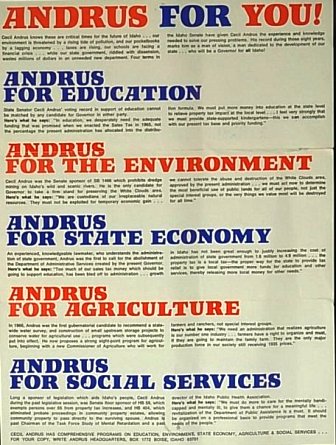
Did I ever mention how I got really interested in politics? It was spring 1970 when a knock on my apartment door in Pocatello, Idaho revealed Cecil Andrus, who had announced the prior month that he was going to run for governor of that rural, agricultural state.

It was another one of those watershed events that, in retrospect, changed my life, although at the time it seemed like a way to avoid the Vietnam War for a year or two, and to take a semester off from college. I really wasn’t intending to change my life.

Back then, state-wide campaigns started about three months before the primary, and maybe nine months prior to the general elections in November. Ah, the good old days of short election cycles!


I was 21 years old and finishing my junior year at the university, studying journalism. I was slated to attend U.S. Army boot camp that summer as a part of officer training – a prospect I was not looking forward to, not at all. I knew that a summer with the Army was the precursor to being sent into the Vietnam War after graduation, sent off with a bright second lieutenant’s bar on my helmet, a bar that I had heard the enemy liked to aim their rifles at.

I had known of the Andrus family for a number of years: They lived in our neighborhood in Lewiston, and “Cece”, as he was called, was my father’s insurance agent. His daughters were somewhat younger than I, and attended the same public schools. Prior to moving to Lewiston, Andrus was a lumberjack in the woods of North Idaho and Oregon.

Andrus asked me that day to join his media staff for the campaign that summer and fall, and I jumped on it. I chatted with the local Army colonel who was bright enough to see that a summer campaigning would certainly make me better able to stare down the Vietnamese when I got into the war a year later than planned.

I joined the Andrus state-wide campaign staff in late May, after classes ended for the summer. I packed up my meager belongings and drove to Boise, the state capitol, where the Andrus group had set up their office. I found a place to live by sharing a small house with three college buddies for the summer, and eagerly reported to work.

I was assigned to the media manager, John Hughes, a Lewiston television news reporter who also took the summer off to join Andrus. The full campaign staff numbered about six, and all had Lewiston ties.

I was expecting to write press releases and distribute them, join policy discussions, and hob knob with the rich and powerful of the State. That didn’t happen.


I spent the summer driving the politician from event to event, standing in the wings to keep him on a tight schedule, and passing out brochures while the candidate was shaking hands and meeting people. We covered the state many times over that year, driving the winding mountain roads in the North to the potato fields in the East, 500 miles in each direction from Boise, piling thousands of miles on the Andrus family station wagon. We spent weeks away from “home” in Boise, campaigning in the many small towns of the state, and the few small cities, too (there weren’t any large cities then, outside of Boise’s population of 60,000, the next largest town had 35,000).

It wasn’t what I was expecting – I was anticipating an intellectual summer of influence building – but it turned out to be hard work, long days and weeks on the road, pushing a candidate , listening to his frustrations and joys, and being a good sport about everything, no matter the circumstance.

We typically stayed in people’s homes while traveling, to save precious campaign funds. We ate in more cafes and diners than you can count, and I think we attended all the county fairs and rodeos in the state that year – all 44 of them.

When we drove into any of the small towns where we stopped, typically a local supporter had arranged for a “meet and greet” gathering, where ten to a hundred people might have gathered to meet and hear the candidate Andrus. We would always run the candidate to the local radio station, stop at the local daily or weekly newspaper for an interview and to plant a few prepared photos, then move on to the next town, the next event. We would find the local television station too, if the town had one (there were only about five TV stations in the state, then).


The staff back in Boise would arrange our schedule to the minute, while banging out press releases, organizing supporters, and mailing thousands of letters and promotional material.

Andrus had won the primary election early in the year, and we were in a tight race to unseat the incumbent governor, Don Samuelson. This was the second time Andrus ran for governor, losing to the same Mr. Samuelson four years earlier.

We won that election of 1970, beating the Republican governor by five percentage points, in what was historically a conservative, Republican state. Andrus was the first Democrat elected in that state in decades, and he went on to win four terms over the next 20 years. He also served as Jimmy Carter’s Secretary of the Interior.

From my viewpoint, that election campaign changed many things in my life, and changed my destinies: Instead of accepting a job on the new governor’s staff, I returned to college the next semester to get my degree (it turned out to be two degrees, as the University gave me a lot of credits for working on that campaign, no doubt to impress Andrus and keep their state budgets well funded). The campaign experience delayed my entry into the Army by a year, and hence I was not sent to Vietnam as that war was winding down. That campaign created a love of observing politics, which helped drive my future media career which is still on-going. And that campaign experience gave me the confidence to run for public office 12 years later.

It’s funny how fate can intervene in life – my decision to go to the particular university I did, a decision to chair a college convention one year that as a result, lead to the Andrus campaign offer – decisions that are made today that really do have unintended consequences, good and bad, years later.

(c) 2010 Stephen J. Matlock. This publication is the exclusive property of Stephen J. Matlock and is protectedunder the US Copyright Act of 1976 and all other applicable international, federal, state and local laws. The contents of this post/story may not be reproduced as a whole or in part, by any means whatsoever, without consent of the author, Stephen J. Matlock. All rights reserved.

Sunday, November 13, 2011

Sundays with Steve - NOT!

So... late Saturday afternoon after Mr. Jenny and I had worked through about 23 1/2 million items on our to do list, I said, "Did you send me your Sunday post?"

And Mr. Jenny said, "I'll write it on Saturday."

And I said, "Today is Saturday."

And Mr. Jenny said, "No, it isn't, it's Friday."


And I said, "Ummmm...hellllooooo...it's Saturday. Remember yesterday you walked out to the mailbox and there was no mail and you tried to go to the bank and there was no banking and that was because it was Veterans Day which was on Friday?"

And Mr. Jenny said, "Oh yeah. Saturday."


And didn't give me a post anyway.

So here ya go.

A non-Sunday's with Steve post.

And since it's technically not my day to write anything, I'm signing off now!

So there!

post signature

Sunday, November 6, 2011

Sundays with Steve - I'll be a standing on a corner...

These Sunday's segments are written by my husband, Mr. Jenny. Here's what he has to say about his posts:

I’ve been writing these weekly stories about life in Northern Idaho, as a youngster and as growing into a young man, primarily for our family. And I'm delighted to share them with you. Just between us, I’m anticipating being cranky when some whipper-snapper who may not even be born yet harasses me in 30 years or so with 'Grandpa, tell me about when you were a boy.' That will probably be after the mad cow disease has set in and erased whatever memory is left. So these are the not-so-dramatic adventures of a Baby Boomer in the 1950s, 60s and 70s.

Standing on a corner...

Sunday story? Thanks for taking a peek, but not this week.

There’s a wedding anniversary to celebrate, and Mrs. Steve and I are getting out of town for a couple of days to do just that.

If you want to drop by for coffee, if you happen to be in the neighborhood this weekend, here’s where we'll be.


This is a great old hotel on the national historic register, the La Posada in Winslow, Arizona. We’ve been wanting to visit it for some time. It was built in 1929 by the Santa Fe Railroad, and the current owners began restoring it about 10 years ago.

And it’s located on Route 66. In Winslow, Arizona. You remember Winslow don’t you, from The Eagles song?

Well, I'm a standing on a corner
in Winslow, Arizona
and such a fine sight to see
It's a girl, my Lord, in a flatbed
Ford slowin' down to take a look at me


We’ll be back next week.

PS. Note from Mrs. Steve. Yeah, buddy. It's our Anniversary. There better not be any flatbed Ford girl looking from you, buster!

(c) 2010 Stephen J. Matlock. This publication is the exclusive property of Stephen J. Matlock and is protectedunder the US Copyright Act of 1976 and all other applicable international, federal, state and local laws. The contents of this post/story may not be reproduced as a whole or in part, by any means whatsoever, without consent of the author, Stephen J. Matlock. All rights reserved.

Sunday, October 30, 2011

Sundays with Steve - A Halloween Story

These Sunday's segments are written by my husband, Mr. Jenny. Here's what he has to say about his posts:

I’ve been writing these weekly stories about life in Northern Idaho, as a youngster and as growing into a young man, primarily for our family. And I'm delighted to share them with you. Just between us, I’m anticipating being cranky when some whipper-snapper who may not even be born yet harasses me in 30 years or so with 'Grandpa, tell me about when you were a boy.' That will probably be after the mad cow disease has set in and erased whatever memory is left. So these are the not-so-dramatic adventures of a Baby Boomer in the 1950s, 60s and 70s.

A Halloween Story

On occasion the grandlittles ask for a story, usually when driving them home after they spend the day with their favorite babysitter, Mrs. Steve. Last week they asked for a scary Halloween story. I told them this one, adding a bit of detail to this written version.

Dr. Reed and his wife Rebecca had built the mansion in 1919 on timber lands his father had purchased from the railroad 50 years before, a time when the region was empty of people. It was the occasional summer hunting grounds for a small nomadic tribe of Indians, and it also gave up a harvest of camas root each year. There was virtually no civilization in the region, it was an empty quarter on the West side of the Rocky Mountains, devoid of people, but rich in timber and minerals. The nearest railroad was in Spokane, a two- day wagon ride to the South.

The Reeds built the mansion as their wedding present to each other, he over-seeing the two year construction of the structure, and she securing the furnishings and decorations from the finest stores of the East.


Dr. Reed -- Eugene to just a few people -- and Rebecca had met when he was in medical school at Harvard, and she was studying at the exclusive women’s Smith College. The heart attack and death of his father brought him back to the West, and forced him to take over the family tree harvesting business and mining operations. He never did practice medicine, which he always regretted, but he did insist on the title “doctor” be used by all when addressing him. Rebecca viewed the move West as an adventure, she had never been further than Rochester, and for her, it was.

The mansion was of a grand European style, 40 rooms on three floors plus a basement, with each room having one or two fireplaces to warm its massive interior during the cold Northern winters. It still stands today, a monument to a gilded age long past.

Their three daughters sometimes visit the site of their parents’ death, sometimes bringing their own daughters, and now their granddaughters, to the mansion that over-looks Lake Reed, named after their parents. The exterior of the mansion is all stone, excavated just a few miles away and dragged by mule and the army of workers who spent the years building the place. The massive roof is held up by beams hued from large cedars, and still rot resistant today although the winter rains do seep into the top floors now, contributing to the gradual crumbling of that edifice.

Julia remembers the night well, and still shudders in her memories, her two sisters equally haunted by that night long, long ago when they were but girls.

It was Halloween, 1933, an early winter storm has coated the surrounding pine forest in a light snow, giving the girls a promise of the coming holidays when Dr. Reed’s mother and his brother and family would arrive for an extended stay, bringing the girl’s numerous cousins. The snow was not deep this early, but enough to cover the pine boughs and bring down the reminding golden leaves in the forest. Fall had been short that year, Indian summer had lasted until just a few weeks before that first winter storm.

Dr. Reed had sold timber on the thousands of acres surrounding the mansion, and was easily able to afford the help to keep the mansion running: The men who tended the grounds through the summer, who laid in the abundant fire wood supply for the winter months, and who kept the mansion in fresh wild game and vegetables from the gardens. Then there were the maids who kept the mansion running, the cooks, the upstairs maids, the laundress, the nanny’s, and the girl’s live-in teacher, Mrs. Scoggins.

That late afternoon James, the horse barn steward, gathered the girls for their traditional Halloween ride to the neighbors, and a bit of trick-or-treating. There weren’t many neighbors, the closest about two miles away, and tonight they would take the sleigh for the first time of the winter, pulled by the old mare.

Julia dressed herself as a scary witch, her sister Riley as a circus clown, and young Morgan, of course, as a princess. The girls spent most of the day dressing and putting on make-up, so by late in the afternoon, as the early winter sky started to darken, they were ready to delight the neighbors and hopefully, delight themselves with a reward of candy.

The mansion itself would not receive any trick-or-treaters that night, it was too isolated and distant from any neighborhood children, and in the depths of the great depression, there were not many people living in these lands far from any town or city.

The maids did have all 60 fireplaces roaring that afternoon, warming the building against the winter winds. The mansion was brightly light and decorated with fall colors, a pot of chili was simmering slowly on the stove, and the promise of hot chocolate was waiting for the girls return. Spirits were high among the staff, and the girl’s parents were happy to see them decked-out in their costumes. The maids made a big fuss over them, to the delight of the witch, the clown, and the princess. The parents would not be going trick-or-treating with them, but they were anxious to help them sort their candies when they returned in just an hour or so. They fed the girls a quick bowl of chili to hold them over – the girls really didn’t want to eat, they were much more anxious about the expected candy.

James helped the girls into the sleigh that he had brought around to the kitchen door, and with a “hi-ho”, they were off on an evening they would never forget.

Two hours later, the girls and the steward returned to the mansion, well sated with candy extorted from ten different houses. They were chilled, in a good way, from the brisk cold wind blowing on their faces in the back of the sleigh. James brought the old mare and sleigh to a halt at the back kitchen door, and the girls piled out, running into the kitchen to show off their collection to the cook, the maids, and to their mother.

The kitchen was empty. “Hello, hello!” they called out, but there was no answer. “Hello, hello, where is everybody?” There should have been two or three people in the kitchen, but there was no one. The pot of chili was still steaming on the stove.

“Hello, mother, hello? Father?” There was no answer. “Hello, hello!” Nothing. The girls ran to the dining room, then to the parlor, then to the library where Father always spent his evenings reviewing the books of the company. There was no one.

“Hello, hello, is anyone here?” There was no answer.

“Riley,” Julia said, “what’s going on?” “I don’t know,” her sister answered, “but look, all the fireplaces are stoked, someone must have put wood in all of them just a few minutes ago. This is weird.”

“This is more than weird,” said Julia, “they must be playing a trick on us.”

“I’m scared,” cried the princess Morgan. “It’s ok,” said Riley, “we’ll find them,” as she tried to sooth her younger sister.

The girls were convinced that their parents and the mansion staff were hiding from them, but the silence of the building was disheartening, and all they could hear was the winter wind outside, and the crackling of the wood in the fireplaces in each room.

“Riley, let’s go upstairs, “said Julia. “James, James, would you come with us?” James was not there. “James,” Julia cried out, “where are you?” There was no one there. “Wasn’t he just with us,” asked Julia, “Wasn’t he with us in the kitchen?”

“I don’t know,” said Riley. “I’m not sure he came inside with us.”

“I’m scared,” cried Morgan.

The girls ran down the long hallway back to the massive kitchen. It was empty. “James, James, where are you?” He wasn’t there. They ran through the back door, the sleigh and mare where standing there in the falling snow, but James had disappeared.

The girls began to panic, running back into the kitchen and into the mansion’s grand hall-way.

“What was that!?” Julia cried, the goose bumps rising on her arm, and not from being cold. “What,” said Riley, “I don’t’ hear anything.” A sound traveled through the mansion, it could have been the wind outside that was now blowing fiercely. It was a howl, high pitched, loud, but not deafening. “I hear it now” said Riley, “what is that?”

The mansion turned cold, although all of the fireplaces were blazing. The girls turned colder. “Let’s go upstairs, altogether” said Julia, still in her witch costumer. The three girls slowly climbed the grand staircase, one of three in the mansion rising to the second floor. The howling of the wind grew. “Hello, hello!” They kept crying, but no one answered them.

“I’m scared!” said Morgan, “Yes,” said Julia, “I maybe a little scared too.”

They got to the second floor, and found nothing. “Search all of the bedrooms,” cried Julia. “No!” said Morgan, “I’m not going alone.”

“OK, baby,” said her older sister, not really meaning it.

The three girls then ran room- to- room, all eight bedrooms, and covered the entire floor in just minutes. There was no one there. The fires were all burning brightly, and putting out a lot of heat.

The night grew darker, the winter storm building on the outside of the mansion.

“Hello, hello, where is everybody?” they cried. “This isn’t funny anymore, please come out!”

There was nothing. There was no one home.

The girls crept up to the third floor, where the maid’s rooms were, and the girls’ large playroom.
“Hello, hello!, where is everyone?”

There was no one. “How can this be,” asked Riley? “Where are they? Julia, I’m afraid too!”

“Wait, listen,” cried the witch, “Do you hear that?” What, said her sisters, what?

“Listen.” The girls heard it, a clunking noise, right below them, downstairs. “Quick! Let’s go down there.” They ran to the second floor, yelling for their parents, yelling for the maids, yelling for James the steward, yelling for anyone.

“In here,” said Julia, entering their parents’ bed chamber. They ran in, but the room was empty. No one was there. Morgan was crying, Riley was trying to calm her, but Riley was having a hard time too, keeping her fear down.

“Downstairs, quick,” cried the oldest sister, “I think they are in the library.” They ran to the bottom floor, and searched the library, then the kitchen once again. There was nothing.

They were standing in the kitchen, crying, when all three girls felt it, as if someone passed through the room, a rush of air pushing at them, the door to the outside slamming open, and the temperature of the room dropping by 40 degrees in an instant.

They were stunned. They screamed. They ran from the mansion as fast as they could get out of the kitchen door, not knowing what to expect next.

“And we never saw them again,” said Julia, 65 years later, “We never found out what happened to my parents, your great grandparents, or the ten people who were in the house that night. There was never a clue.”

They were sitting around a camp fire on the shore of Lake Reed, watching the evening fall, roasting a marshmallow, Julia and her three granddaughters.


“ I hear from them on occasion, I think, when I’m out here in the evening. I can look up at the old mansion over there , and I sometimes hear that clunk, and I sometimes feel that cold wind, and I sometimes hear that howling I heard so well that night. If I stay up late enough, I can sometimes see a dim light making its way through the hallways. I’m sure it is my mother still looking for us.

“Oh, look now, girls, look now.”

(c) 2010 Stephen J. MatlockThis publication is the exclusive property of Stephen J. Matlock and is protectedunder the US Copyright Act of 1976 and all other applicable international, federal, state and local laws. The contents of this post/story may not be reproduced as a whole or in part, by any means whatsoever, without consent of the author, Stephen J. Matlock. All rights reserved.

Sunday, October 23, 2011

Sundays with Steve - A husbands guide to tap dancing...

These Sunday's segments are written by my husband, Mr. Jenny. Here's what he has to say about his posts:

I’ve been writing these weekly stories about life in Northern Idaho, as a youngster and as growing into a young man, primarily for our family. And I'm delighted to share them with you. Just between us, I’m anticipating being cranky when some whipper-snapper who may not even be born yet harasses me in 30 years or so with 'Grandpa, tell me about when you were a boy.' That will probably be after the mad cow disease has set in and erased whatever memory is left. So these are the not-so-dramatic adventures of a Baby Boomer in the 1950s, 60s and 70s.

A Husband's Guide to Tap Dancing

“Did you know that some husbands go clothes shopping with their wives?” Mrs. Steve asked early this morning. “No,” I answered with some trepidation, and thinking why on earth would husbands do that? “I haven’t thought about it, why do you ask?”

“Oh, no reason,” she said. I knew there was a reason, and I mentally braced myself. It was 5 a.m., and conversation like this one to start the day, rarely have a good outcome.

“You’ve never gone shopping with me.” Oh, oh.


“Of course I have,” I replied, “several times.” Several times in the 12 years we’ve been married, that’s about right. What is several, and why is she asking?

“Why, just a few years ago you needed some a couple of new shirts for a long weekend in the mountains, do you remember?”

“No,” she replied, “I don’t remember that at all.”

“Of course,” I said, “We were in that little dressing room at Target, and you had about 30 different shirts to try on.” I actually remembered it. It turned out to be 50 or 60 to try on, it took about two hours, and she bought one shirt. Why do husbands go clothes shopping with their wives? I don’t have a clue. Abject boredom , maybe? I avoid it like the black plague.

“Oh, wait,” she said, “I remember, that mall on the way to Tucson, we went there once when I needed a dress for one of the parties.” I didn’t remember that at all. “Yes,” I said, “that must have been the Dress Barn.” It was a good guess.

“I’m sure there have been other times, too. There have been weddings we’ve gone to, anniversaries, birthdays, we’ve done a lot of shopping together over the years, “ I said, and then in a whisper, “Just don’t ask me to name them.”

“OK,” she said, “I guess you are off the hook.” Thank you Lord, that was close.

“Dear,” she said this afternoon, as we were going out to run a couple of Saturday errands, “there is another place I want to stop this afternoon, I need a few clothes.” Oh, oh, I said for the second time today. Here is comes.

But then the surprise. “You might want to bring a book along.” “Huh?” I stuttered, “Why would I want to do that?”

“Well, you might want to wait in the car while I go in the store.” OK, I think, I can live with that. We do that sometimes when she does quick runs into stores and I park in the no-parking zones near the front doors, keeping the car cool in the hot Arizona summers. But waiting at the curb for an hour or two might be pushing my luck with the local parking police.

“Or maybe you can wait for me in the sports bar next door to the dress shop and watch the football game.”

What? What did she say? College football game in a sports bar? “Well yea, would you like some extra money for accessories?” I asked. “Take your time, please take your time!”

How did that happen? Mrs. Steve must have been reading my mind. This is a win / win for both of us. Mrs. Steve has always had my number, she has it down pat. She knows what works, and what doesn’t work so well in our relationship. Was that manipulation? Am I being hopelessly male and shallow? Yes, maybe, probably, but as long I can have a burger and a beer with the game on that big screen TV, I’m a happy shopper, and so is Mrs. Steve.
(c) 2010 Stephen J. MatlockThis publication is the exclusive property of Stephen J. Matlock and is protectedunder the US Copyright Act of 1976 and all other applicable international, federal, state and local laws. The contents of this post/story may not be reproduced as a whole or in part, by any means whatsoever, without consent of the author, Stephen J. Matlock. All rights reserved.

Sunday, October 16, 2011

Sundays with Steve - Eagle Visitors

These Sunday's segments are written by my husband, Mr. Jenny. Here's what he has to say about his posts:

I’ve been writing these weekly stories about life in Northern Idaho, as a youngster and as growing into a young man, primarily for our family. And I'm delighted to share them with you. Just between us, I’m anticipating being cranky when some whipper-snapper who may not even be born yet harasses me in 30 years or so with 'Grandpa, tell me about when you were a boy.' That will probably be after the mad cow disease has set in and erased whatever memory is left. So these are the not-so-dramatic adventures of a Baby Boomer in the 1950s, 60s and 70s.

Eagle Visitors!

On occasion we get interesting visitors here in Arizona, in addition to the Mrs. Steve’s blog friends who stop by, and the grands who spends as much time as they can here.

We live in a metro area of about 4-million people, where we don’t often see wildlife in the city. I think I told you last year about the coyotes we sometimes see wandering our streets and alleys. And I often hear owls in the trees at night.
This week’s visitor has been hanging around for a week or so, and we see his relatives every year or two, as well. They are scouting the neighborhood for food. These Golden Eagles are raptors, and they are hunting for rodents, snakes, and other delicacies. Mrs. Steve reports finding a few balls of fur in the lawn, so apparently the eagle’s hunting is successful. We think these birds are non-adults, less than a year old.

The grands were here this week when the eagle pictured below landed on a tree outside the kitchen. We all watched it for quite a while, and we were able to shoot a few photos.


(c) 2010 Stephen J. MatlockThis publication is the exclusive property of Stephen J. Matlock and is protectedunder the US Copyright Act of 1976 and all other applicable international, federal, state and local laws. The contents of this post/story may not be reproduced as a whole or in part, by any means whatsoever, without consent of the author, Stephen J. Matlock. All rights reserved.

Sunday, October 9, 2011

Sundays with Steve - Cooking to Win!

These Sunday's segments are written by my husband, Mr. Jenny. Here's what he has to say about his posts:

I’ve been writing these weekly stories about life in Northern Idaho, as a youngster and as growing into a young man, primarily for our family. And I'm delighted to share them with you. Just between us, I’m anticipating being cranky when some whipper-snapper who may not even be born yet harasses me in 30 years or so with 'Grandpa, tell me about when you were a boy.' That will probably be after the mad cow disease has set in and erased whatever memory is left. So these are the not-so-dramatic adventures of a Baby Boomer in the 1950s, 60s and 70s.


Cooking to Win!


I’m not much of a cook, never have been, which is maybe why I thought I could enter a local cook-off ... and actually win.

My good friend, Ed Griffith, lived just a couple of doors down in our quiet, rural subdivision in Eagle, Idaho. We both spent many years in North Idaho where we became friends, and we arrived in Eagle from different directions and with different career paths. It was happenstance, maybe fate in 1981, that landed us just two doors apart; I was moving back to the Boise –Eagle area from Montana, and he had moved the 300 miles from North Idaho the previous year. We did not know we were becoming neighbors until I called him, to tell him the news that we were moving to Eagle.

For a number of years, another neighbor and I would take our small children around our neighborhood on Halloween, trick or treating the 60 or so houses that made up our subdivision. The wives would go ahead to our last stop, with food and treats. The last stop was always at the Griffith’s, where Ed and his wife Bonnie would spend the day making a delicious chili to feed those of us who had braved the ghosts and goblins. Halloween would end there, with the kids inventorying and sampling their take of candy for the night, and the adults enjoying a feast.

Once or twice a year Ed would go hunting out in the wilds of Idaho, and typically come back with deer or elk meat. The elk meat became the prime ingredient in his chili.


One year after Ed had demonstrated his culinary skills once more -- that time by incinerating a whole pig to just a few bits of charred carbon, a pig that had been buried in the ground for 18 hours or so over too hot coals -- we decided we should enter his excellent chili in a local cook-off that was coming up in June.

We couldn’t imagine that anyone could craft a better tasting chili than Ed’s elk meat creation, a savory mix of meat, beans, tomatoes, onions, and heavy spices. We spent several weeks perfecting the receipt, cooking it each weekend until we were fully satisfied that it was unbeatable. Oh, did I mention the bourbon? That was a key ingredient as well, usually for the cooks, and it probably contributed to our culinary confidence.

The big weekend came. It was Eagle Fun Days, which I have told you about in these stories earlier, an annual local celebration that brought thousands to our little town for a fireman’s parade, street dances, the Rocky Mountain Oyster Feed, and that year, a chili cook-off.

The rules allowed us to pre-chop the ingredients, but not to pre-cook anything. We spent Friday evening chopping the elk meat, the tomatoes and the onions, and assembling the other ingredients in boxes. And maybe sampling the bourbon, just a touch, you know, to be sure it tasted right.


By eight Saturday morning we showed-up at the cook-off site, a parking lot at the main intersection (there was only one, then) of town. We set up two gas camp stoves, and began browning our ingredients in two large skillets. We anticipated giving samples of the chili to several hundred people, so we were making a full five gallons of the stuff.

Our cooking was proceeding fine by nine, when an inspector from the State Department of Health stopped by to look at our food handler’s licenses, and our public restaurant license. Our what??? He was only kidding, he said as I tried to recover from my heart attack, but he did show us how to properly wash utensils and anything that came in contact with the food.

With our chili simmering nicely, we strolled through the competitor’s tents to see how they were fairing. We knew most of the competitors, and saw that it was a friendly affair. We were not anticipating any dirty tricks. The competitors were very conventional in their ingredients, and I knew we had this competition in the bag.

The judging was at eleven, and the last hour was frantic as we stirred in the final ingredients and worked the seasoning so that it was just right – not too hot, but not tame, either, and not to over-power the distinct and delicious flavor of the wild elk meat.

The public started through the tents, and each person received a small Dixie Cup of chili to sample. I think each had to buy a five dollar ticket for the privilege of tasting our incredible creation, plus samples of the slop our competitors obviously threw together at the last minute, without the weeks and months of planning that Ed and I put into the task. Our kitchen was first in the tasting line, so we received universal praise from most of the people coming through the line. Some didn’t voice an opinion of our chili, and some grimaced just a touch. That may have been a hint. Each person then voted on the best chili at the end of the tasting line.

The three judges came through the line along with the public, made polite chewing sounds, and moved on.

By noon, and just before the fireman’s parade was scheduled to start, we had closed the sample line and began cleaning up our cooking areas. The judges called out to gather around for the long awaited announcement.

“And the winners are,” said the head judge, an obvious New York City transplant who had never tasted wild game in his entire, pathetic little life, “First, thanks to everyone who participated...” blah, blah, blah, come on now, get on it with. There were five teams, and we were sure we had won first place.

“Now,” said the obviously ignorant judge who wouldn’t know a rattle snake from a milk cow, “The public and the judges’ ballots are identical, we all agree.”

Public ballots are the same? Who are these morons, anyway? Transplants from Los Angeles and San Francisco and Seattle who have invaded our little corner of paradise, for whom someone had published the bumper stick as early as 1965 saying ‘Don’t Californicate Idaho’, immigrants from the Coast coming to the wilderness to seek a better life.

“In fifth and last place, with a unique western chili that was appreciated by all, is the team of Griffith- Matlock.” Excuse me? Last place? What?

In the end, we were big boys and gracious in our defeat at the hands of these outsiders, these know-nothings, these, these, these.... not that I was bitter mind you, but really, who in their right Idaho mind wouldn’t prefer elk?

Or maybe, just maybe, just the slight outside chance, the ever-so-nil possibility, that the elk chili was close to horrendous? Maybe.


(c) 2010 Stephen J. MatlockThis publication is the exclusive property of Stephen J. Matlock and is protectedunder the US Copyright Act of 1976 and all other applicable international, federal, state and local laws. The contents of this post/story may not be reproduced as a whole or in part, by any means whatsoever, without consent of the author, Stephen J. Matlock. All rights reserved.

Sunday, October 2, 2011

Sundays with Steve - Speaking of Circus Monkeys

These Sunday's segments are written by my husband, Mr. Jenny. Here's what he has to say about his posts:

I’ve been writing these weekly stories about life in Northern Idaho, as a youngster and as growing into a young man, primarily for our family. And I'm delighted to share them with you. Just between us, I’m anticipating being cranky when some whipper-snapper who may not even be born yet harasses me in 30 years or so with 'Grandpa, tell me about when you were a boy.' That will probably be after the mad cow disease has set in and erased whatever memory is left. So these are the not-so-dramatic adventures of a Baby Boomer in the 1950s, 60s and 70s.


Speaking of Circus Monkeys!

My friend Bill Mitchell was subtle, quirky, a bit “off” maybe. He was a banker, or at least the small independent bank in Meridian, Idaho paid him to be a loan officer at its sole branch. He hated it, in those years. He was much more comfortable playing his horn with the famed jazz pianist Gene Harris most weekends at the old Idanha Hotel in nearby downtown Boise. He was quite good at that.

We would meet some Thursday evenings after work for cocktails at Bill’s Lounge, a honky-tonk just off Main Street and within a few feet of both the bank office and the newspaper where I worked.

For a period of six months, Mitchell would come into the bar, sit down, order a drink, and ask those at the table, “Have you seen my monkey?’ Nobody knew what he was talking about, and he wouldn’t explain. Like I said, he was a bit quirky.


That summer the Bill Kay Shrine Circus came to our small town. Mr. Kay, the owner, did the advance work and came to my office one day, offering free tickets for our newspaper carriers and looking for news coverage of the coming events.

I asked a special favor.

“Bill, I need to borrow a monkey,” I said. “Huh?” Was the reply I received, I think. I told him that one of my friends, a local banker, and gone a bit nuts and thought he lost his monkey. I’d like to borrow a monkey for an hour or so, to play a joke on Mr. Mitchell, the banker.

“Sure,” said the circus manager, “I’ll send one over along with a trainer.”

The next day was Wednesday, the day when we typically attended the weekly Kiwanis service club luncheon. The trainer and the monkey showed up about 11.30. Mitchell usually expected me at a quarter to twelve, to drive together to the Kiwanis lunch. This day I had a surprise.

I walked through the front door of the bank, it was crowded with customers, and Mitchell was at his desk toward the back of the lobby, helping a young lady open a new checking account. I yelled loudly across the lobby, “Hey Mitchell, I found your monkey, and here it is!”

The bank went dead silent as the customers and employees stared at me, and at the monkey following me through the front door. Then the laughter started. I had the newspaper’s photographer along as well, he was busy taking pictures.

“Mitchell, here,” I yelled again, “I found your monkey, he was across the street looking for you!”

Mitchell was speechless, and quickly turned red with embarrassment.

We walked to the back of the bank lobby where Mitchell’s desk was located, the monkey jumped on the desk and put his arms around Mitchell’s neck. The photographer was in full picturing taking mode. The new customer sat in awe. Mitchell just grinned, and his face continued to redden in embarrassment. The bank guard woke up and came running, trying to rescue his boss from the kisses the monkey was planting on Mitchell’s cheek.

We walked the monkey over to the small teller line where the monkey climbed up on the counter to greet the employees and customers; he was a very polite monkey, and he shook everyone’s hand. Mitchell tried to finish up with the new customer but could not, and turned the task over to another bank employee.

Mitchell was still speechless, but found his voice when he discovered we were taking the monkey to the Kiwanis luncheon, which usually had 30 or 40 local business people in attendance. Mitchell objected, but not very hard, and we put the “Hey Mitchell, I found your monkey” show on again once everyone was seated in the restaurant’s banquet room.

The trainer took the monkey back to the circus after it shook everyone’s hand at the banquet tables, giving the crowd a good laugh at Bill Mitchell’s expense.

I ran a picture of Mitchell and the monkey in the newspaper the next week, as a part of the promotion for the circus show.

And from that day forward, Mitchell never again asked, “Have you seen my monkey?”

(c) 2010 Stephen J. MatlockThis publication is the exclusive property of Stephen J. Matlock and is protectedunder the US Copyright Act of 1976 and all other applicable international, federal, state and local laws. The contents of this post/story may not be reproduced as a whole or in part, by any means whatsoever, without consent of the author, Stephen J. Matlock. All rights reserved.

Sunday, September 25, 2011

Sundays with Steve - Holy Elephants!

These Sunday's segments are written by my husband, Mr. Jenny. Here's what he has to say about his posts:

I’ve been writing these weekly stories about life in Northern Idaho, as a youngster and as growing into a young man, primarily for our family. And I'm delighted to share them with you. Just between us, I’m anticipating being cranky when some whipper-snapper who may not even be born yet harasses me in 30 years or so with 'Grandpa, tell me about when you were a boy.' That will probably be after the mad cow disease has set in and erased whatever memory is left. So these are the not-so-dramatic adventures of a Baby Boomer in the 1950s, 60s and 70s.

Holy Elephants!

Lillian McSorely’s eyes were the size of dishes, her scream should have been broken the glass window of the lunch counter she just walked out of, her friend and companion Miss McMillan was near fainting in fright, and neither could believe their eyes. The two young school teachers were frozen in the face of the certain death rampaging toward them. Nothing like this had ever happened in our small town.

The circus has pulled into town that day, a 100 mile train ride up the river from Walla Walla, Washington. The cars were pushed onto a spur on the shore of the Snake River, a grassy area the Sells-Floto circus had set up on for the past several years. It was 1928, the country’s prosperity was going strong, and the circus business was quite good that year.


The wagon master began unloading the animals that fateful afternoon, as he had done many times before: the lions, the tigers, the two giraffes, a camel, cars of horses, and of course monkeys, tons of monkeys. A rail car of six elephants was last, and the last out was that cranky elephant named Mary who decided she wasn’t going to play circus that day, but would rather take a walking tour of our town. It was a hot day, and the later speculation was that the elephant was thirsty, that she was simply looking for a drink of water.

The circus grounds were just a short walk from Main Street, maybe 100 yards at the most, and Main Street is where the elephant headed, circus men running after the big grey beast, trying to corral it back in. The elephant named Mary would have none of it, and ran at full speed up Main Street, knocking cars aside, blowing her trunk at full blast, and breaking glass windows of businesses as it rampaged up the street.

Our small town was a busy place in those years, a commercial center that drew lots of people for a late Saturday afternoon at the circus. Miss McSorely and Miss McMillan both worked for the Lewiston School District. I knew both, McSorely as the stern and somewhat frightening principal of the elementary school I attended 25 years later, McMillan the art teacher who rotated among the town’s four elementary schools. The two ladies shared an apartment at the Lewis-Clark Hotel, which was the gateway to Main Street for the town.

As Miss McSorely told me years later, they were across the street from the hotel, finishing an early afternoon meal at their favorite lunch counter, when they saw people running down the sidewalks, yelling. They quickly paid their tab, and made their way to the front door and out onto the sidewalk.

What they found was like nothing they had ever experienced: Mary the elephant running full steam, bellowing, heading straight at them. She was running up the side-walk, breaking windows of businesses she passed, and with circus men were following and yelling for everyone to get out of the way. Both school teachers screamed, froze in place for a moment, but then quickly regained their wits and dashed into an automobile garage next door.

What happen next is taken from a circus magazine of the time:

It was in this midst that the Sells-Floto circus pulled into the town of Lewiston, Idaho back in August 8, 1928. The temperature was over 100 degrees. Elephant trainers were having difficulty getting the elephants out of their cages. There was no water anywhere.

A huge Asian elephant named Mary got thirsty. She broke away from her trainers and dashed down a crowded Main Street, looking for a drink. According to reporters, as she ran, she mistook store front windows for shimmering pools of water, and repeatedly smashed them, spreading glass, noise and panic throughout the business district.


Elephant trainers managed to get in front of Mary in an effort to disperse the crowds, but missed two schoolteachers, who were chatting near a garage on the 300 block. Inside the garage, someone had been washing cars. Mary caught the scent of water and trampled towards it.

Meanwhile, someone alerted the mayor, Dr. Braddock, who was not only the mayor and a doctor, but also an accomplished big game hunter. He immediately went home for his gun.

The teachers ran screaming into the garage and up the stairs to a mezzanine and safety. Mary reached water. Handlers arrived to calm her down. Then Dr. Braddock entered with his gun, and with several well-placed shots, sent another Sells Floto elephant packing their trunk to the great circus in the sky.

Today, Mary's trunk is displayed in a private collection. And there is a small plaque at the site of the old garage, telling people that a elephant was shot here, when "She was only trying to find a drink of water!" We say the plaque ignores the climate of the times, one in which traveling elephants routinely broke free and rampaged. The mayor was re-elected.


(c) 2010 Stephen J. MatlockThis publication is the exclusive property of Stephen J. Matlock and is protectedunder the US Copyright Act of 1976 and all other applicable international, federal, state and local laws. The contents of this post/story may not be reproduced as a whole or in part, by any means whatsoever, without consent of the author, Stephen J. Matlock. All rights reserved.

Sunday, September 18, 2011

Sundays with Steve - Earthquake!

These Sunday's segments are written by my husband, Mr. Jenny. Here's what he has to say about his posts:

I’ve been writing these weekly stories about life in Northern Idaho, as a youngster and as growing into a young man, primarily for our family. And I'm delighted to share them with you. Just between us, I’m anticipating being cranky when some whipper-snapper who may not even be born yet harasses me in 30 years or so with 'Grandpa, tell me about when you were a boy.' That will probably be after the mad cow disease has set in and erased whatever memory is left. So these are the not-so-dramatic adventures of a Baby Boomer in the 1950s, 60s and 70s.

Earthquake!

At three in the morning, the city is as quiet as it gets. The streets are empty, the night clubs are closed, the big wholesale markets are not yet open, the constant honking and the roar of car and truck engines are silent. Twenty -six million people sleep.

Until they are waken by a familiar roar, what sounds to be a parade of cement trucks making a mad dash through the city, in leading the charge of chaos they bring, loud enough to wake all, powerful enough to shake the very foundations of the city.

I hear the sliding glass door in my bedroom start to rattle, it opens onto the ninth floor balcony of the apartment where I live. Then it moves into shake mode, the door into the closet slams shut, the door out into the living room swings violently open, a picture on the wall falls to the floor. The sliding glass door is pushing at its frame, frantically trying to open itself, for the long fall to the ground below.

I know immediately what it is, everyone in the world’s third largest city knows what it is, just ten years ago 1,000 died from an earth quake just like this one, when buildings all-over Mexico City fell down, just collapsed, and some tall buildings like this apartment building I’m in, simply fell over on their sides. The photos of some of those buildings lying in the street, not in a piles but virtually intact, building eight or ten or twelve stories tall, lying in the street as if a giant had pushed them over , those photos scared the hell out of me when the building I am in is shaking to its very foundation.


Just two weeks before I was at work early one afternoon at the customer service call center I managed on behalf of several Mexico long distance telephone companies, when the building began to sway. We were on the eleventh floor, and this building was moving dramatically side-to-side. Following the disastrous 1988 quake, the city had upgrading its requirements for most buildings, putting tall buildings like the one I was in, on giant springs to absorb the shock. The quake that hit us that day -- a 6.0 centered a hundred miles away – swayed our building hard. The quake itself lasted just 50 seconds, but the building kept moving for almost five more minutes, like a kids’ swing that slows down after the last push, but keeps moving for a long time before it finally stops Our office building, and many like it in the city, did the same thing, they just kept swinging until the energy of their springs finally stopped the motion. I watched out of my office window in awe, as the city literally swayed before my eyes. Our 200 customer service agents stayed under their desks for another ten minutes, until I, as the bad Gringo, forced them back to work.

The first really significant earthquake I experienced was in the mid-1980s in Idaho, when I heard what I thought was a rambling heard of cement mixers coming down our quiet residential street. I jumped up from the breakfast table and ran to the front door. I saw the school bus outside of the house, picking up neighborhood children, but one of those, my stepdaughter, was running back home, screaming at the top of her lungs. I yelled at her not to go into the house, but she didn’t even slow down. What was remarkable that day were the waves rolling through the earth, like waves of water just under the soil, undulating, lifting the street at they passed, lifting a 100 foot pine tree as if it were a stick, lifting my two story brick house as if it were a play thing; three, maybe four waves moving through the earth at lightning speed. The quake was over in just seconds, maybe one half of a minute. There was no local damage that day, but it did shake up a lot of people, including my father, 400 miles away, who told me that it knocked him off his toilet. A school collapsed near the epicenter three hundred miles away. I flew over that region a few weeks later and I was amazed to see a crack in the earth that quake had created, a crack that from an airliner five miles in the sky, looked to stretch for miles, maybe twenty of them.

My Mexico City sliding glass door was insisting on jumping out of its frame that morning, there was a roaring sound in the neighborhood, much louder than any of the normal rush hour traffic, and I was thinking about those tall buildings in the quake a decade earlier that simply fell over into the streets. I wondered if I was going to go out that doorway to the balcony, and over the edge, nine floors down to the street, once the sliding glass door popped out of its frame and the building began to lean. Would this quake just shake me and my bed out that doorway, like salt being shaken out of shaker, into the street one hundred feet below? Would this building follow me down, crushing me like an ant under a shoe? Gulp.

The shaking stopped, my bed did not jump out the doorway, and I took a deep breath, just another earth quake, I thought, just like the one several weeks ago, just like the next one that will come very soon. Just another day in my life as a Gringo in paradise. I lived in Mexico City for about five years, and probably experienced 30 major quakes in that time. "Don’t worry", said my friends, "You'll get used to the earth quakes." "Yes, right, of course," I said, "I'm sure that I will."

But I thought to myself, "No, that is probably never going to happen." And it didn't.

(c) 2010 Stephen J. MatlockThis publication is the exclusive property of Stephen J. Matlock and is protectedunder the US Copyright Act of 1976 and all other applicable international, federal, state and local laws. The contents of this post/story may not be reproduced as a whole or in part, by any means whatsoever, without consent of the author, Stephen J. Matlock. All rights reserved.

Sunday, September 11, 2011

Sundays with Steve - We remember

I Remember September 2001

After I attended some business meetings Friday morning at the ornate and lovely Library of Congress, Mrs. Steve and I spent a pleasant weekend in Washington, D.C We’d both done the obvious tourist things on many visits over the years, but we had planned this weekend to be a bit different.

We spent hours exploring the Old Executive Office building, next door to the White House, then more hours thoroughly exploring the grounds around Mount Vernon and neighboring Alexandra. We poked into the national Arboretum, and watched Pres. Bush drive by in a motorcade (but we didn’t wave, too touristy). Mrs. Steve consented to go to a fancy seafood restaurant, even though she generally dislikes seafood. It was a very nice couple of days, relaxed, interesting, and enjoyable. Sunday we caught the afternoon America West flight leaving National Airport, and got lucky enough to be bumped up to first class for the uneventful flight to Phoenix.

We settled back into our routines on Monday, until the world changed forever the follwing morning: We both came in from our morning walk along the canal to find our distraught son Greg yelling from the front door, ‘Come quick, look at the TV, an airplane flew into the World Trade Center!’

And my wife, Mrs. Steve, remembers 9-11 in these words:


Where were you when the world stood still?
In that moment the world became changed
With an imprint of terror
Forged forever in fire
When destruction fell down like fall rain?

Were you drinking your coffee?
Were you driving to work?
Were you holding your babe to your heart?
Were you humming a song?
Were you righting a wrong?
Were you ironing your favorite shirt?

Where were you when the world broke in
disrupting your everyday plans
and disturbing the notion
that safety and peace
were the inalienable rights of all man…

Were you calling your Mother?
Were you taking a bath?
Were you going through the motions of your day?
Were you baking a cake?
Were you planning a break up
and trying to find the right words to say?

Where were you when the message came
That nothing in life is for sure?
And all we get is each moment with no guarantees
of tomorrow, next week or next year…

Are you speaking a kind word?
Are you doing your part
to comfort and never cause pain?
Remember those moments
With your head and your heart
So the terror did not happen in vain…

Remember the message, remember the date
Remember nothing in life is for sure
for all we get is each moment with no guarantees
of tomorrow, next week or next year…


(c) 2010 Stephen J. Matlock
This publication is the exclusive property of Stephen J. Matlock and is protected
under the US Copyright Act of 1976 and all other applicable international, federal, state and local laws. The contents of this post/story may not be reproduced as a whole or in part, by any means whatsoever, without consent of the author, Stephen J. Matlock. All rights reserved.

Sunday, September 4, 2011

Sundays with Steve - The 1967 War

These Sunday's segments are written by my husband, Mr. Jenny. Here's what he has to say about his posts:

I’ve been writing these weekly stories about life in Northern Idaho, as a youngster and as growing into a young man, primarily for our family. And I'm delighted to share them with you. Just between us, I’m anticipating being cranky when some whipper-snapper who may not even be born yet harasses me in 30 years or so with 'Grandpa, tell me about when you were a boy.' That will probably be after the mad cow disease has set in and erased whatever memory is left. So these are the not-so-dramatic adventures of a Baby Boomer in the 1950s, 60s and 70s.

The 1967 War

“It is an insult! An insult I tell you, an affront to the civilized world, a world that you and your people have never known, and will never know!”

Dr. Fouad’s eyes were blazing, sweat on his brow, his fist pounding the table in a rage, shouting at the Jewish professor.

“You are insane,” cried the Jew, “We have kicked you back to Egypt where you and your Russian dogs belong, don’t you dare intrude into our lands again!”


I was sitting between those two madmen, astounded, and ducking their verbal jabs. I wondered if Col. Fouad had experience at torture. I wondered if his target had been a member of the Israeli Mossad.

This battle had been going on for years, and then with me now in the middle, it would continue for another year.

The Thursday night fights as I called them, in this corner Dr. Mahmoud Fouad, a former Egyptian Army Colonel, and opposing him, Dr. Robert Lang, defending his religion and the existence of the state of Israel to his last conscious breath. In the middle, me, a college sophomore, wondering what I was doing sitting with my macro economics professor on one side, and my media law professor on the other.

I had connected with both professors that year, engaging each in the exploration of their expertise, Fouad in economics, Lang in media. Both were bachelors at that time, both taught at Idaho State University, both were quite outspoken, and both maybe a touch nuts.

It was spring 1969, the United Nations was forcing Israel to give up lands in the Sinai Peninsula that it had taken from Egypt in the 1967 war. Fouad was ecstatic, Lang besides himself.

“The Egyptian army couldn’t fight its way out of a paper bag,” nagged Lang. “The Isrealies couldn’t find sand in the desert without the help of the Americans,” taunted Fouad, right back at him.

They re-fought the 1967 war almost every Thursday night at Buddy’s, a good Italian restaurant that mostly severed beer to college students from the university that just was just couple of blocks away.


That spring both professors invited me to join them for beer, diner, and war. I did. It was just that, copious amounts of beer, some excellent dinner, and a long, drawn out war, mostly in that order. I noticed, as a bright young journalism student that I was, that the more beer my professors consumed, the more vicious the war became, and the more heated the battles were fought at that table in Buddy’s.

These were the epic battles of best friends, friends who thought their representative countries were both wrong and silly to pursue each other. The friends were intelligent, educated men who understood the history and cultures of those complex lands, and who struggled in frustration to understand the nature of Middle East politics of the late 1960s.

I joined in fighting the wars with them every few weeks for the next year, or it would be more accurate to say, that I joined them as an impartial observer, and dispenser of their beers that they consumed by the gallon. The next spring the wars ended for a while, after Dr. Lang called me at my apartment one Friday morning, the morning of the final exam for one of his classes, asking me to tell the other students in the class that final exam was dismissed, that he was ill and wasn’t coming in, and to have a good summer.

The two professors had invited me to travel to Europe with them that summer, but I reluctantly declined. I did not plan to return to Pocatello for school that fall, and I attended a different university the next year.

I was at the family home in North Idaho late that summer when the telephone rang one evening, and to my surprise, it was Dr. Lang. I believe he and Dr. Fouad had been in the beer at Buddy’s, again: “Mr. Matlock, I need your help,” he slurred. “I have been relieved of my position at the University, they said I have skipped too many classes over the last several years. Could you talk to your cousin on my behalf?”

My cousin on was the state board that over-saw public colleges and universities. He happened to be sitting in the kitchen with me and my family that evening when the telephone call came in. “Sure, I replied, I’ll call you in a day or two.” We did discuss that strange call, but only briefly.

I visited Dr. Lang two years later in Santa Maria, Calif. where he was teaching at a small college after having been dismissed in Idaho. I went to his apartment, a place that smelled strongly of cooking garlic, as did his last apartment in Pocatello. We shared a beer. Then he had another. (I really didn’t like beer then, and I still don’t, 40 years later.)

The telephone rang.

“Really, you Jews have to get out of the Golan Heights before you are wiped off the face of the Earth,” yelled Dr. Fouad over the telephone, “You are going to start a nuclear war between the Russian dogs and the Americans, but you are the people who are going to lose.”

“Never!” shouted Lang, “You Egyptian Arabs are the bane of our existence!”

The war continued.


(c) 2010 Stephen J. Matlock
This publication is the exclusive property of Stephen J. Matlock and is protected
under the US Copyright Act of 1976 and all other applicable international, federal, state and local laws. The contents of this post/story may not be reproduced as a whole or in part, by any means whatsoever, without consent of the author, Stephen J. Matlock. All rights reserved.

Sunday, August 28, 2011

Sundays with Steve - Back to the Beach

These Sunday's segments are written by my husband, Mr. Jenny. Here's what he has to say about his posts:

I’ve been writing these weekly stories about life in Northern Idaho, as a youngster and as growing into a young man, primarily for our family. And I'm delighted to share them with you. Just between us, I’m anticipating being cranky when some whipper-snapper who may not even be born yet harasses me in 30 years or so with 'Grandpa, tell me about when you were a boy.' That will probably be after the mad cow disease has set in and erased whatever memory is left. So these are the not-so-dramatic adventures of a Baby Boomer in the 1950s, 60s and 70s.

BACK TO THE BEACH

We talked last week about driving Miss Daisy to the Oregon Coast for several summers, an annual summer trip for my grandmother and her family to escape the heat of the inland Northwest.

That reminded me of a few other summers on that coast, of the MacDonald’s compound at Seaside, the miles and miles of empty sand beaches, my son’s inaugural pee off the top of the Astoria Column, my brother’s honeymoon Volkswagen washed out to sea, that large freighter threatening to swamp our boat, and a few other stories.

Granby and her family that eventually included my mother and her three siblings, began spending the summers at Seaside, Oregon in about 1910. For 25 years the family would ride steamboats from their home in Lewiston, Idaho, cruising downriver 500 miles to the port of Astoria where they would then travel the 20 miles south to Seaside. After the last steamboat ended service in the 1930s, they drove on the primitive highways to the region. Granby spent her contented summers there every year until she died at the ripe old age of 97.

My family joined them for a number of summers in the 1950s, at least my mother and brothers and I. My father would drive us to the Coast, spend a few days, then return to work in Idaho for a number of weeks before fetching us back to prepare for school. Although in later years it was my treat when I could stay home in Idaho with my father, while the rest of the family was at the Coast.


Those summers were pure: My brothers and I spent most days on bicycles, riding the miles-long concrete board walk, visiting the small amusement park on main street, along with the aquarium, bumper car rides, and Leonard’s salt water taffy stand. We were proficient at finding and catching starfish along the beach, Dungeness crab in the surf, and sea horses in the rocks. My parents would often build bon fires in the beach’s drift wood piles in the late afternoons, where we would watch the sun sink into the sea and eat hot dogs cooked on a stick over the fire.

Granby rented several ramshackle houses from Mr. MacDonald every year from about 1920 through 1960, a block off the beach and within easy walking distance of downtown. The houses were arranged facing each other in a compound with a grassy area between them, so the families could have some privacy but which were still fully accessible to all, especially three young boys who had boundless energy and curiosities to match. There was always trouble in the making.

I’ve returned many times to the Northern Oregon coast, an area of the U.S. unique in its beauty and its ruggedness. Mrs. Steve has become a fan as well over the years, and it is still a favorite of ours.


I took my two small children to visit the Astoria Column one year, a 165 foot attraction that commemorates the history of the area, and over-looks the town of the Astoria and the mouth of the Columbia River where it meets the Pacific Ocean.


Son Chris must have been about 4 years old that year, maybe 5; a little young to climb the iron steps to the top of the column, but more than willing to try, in fact, insisting. So we did. The views from the top of the column are spectacular, it sits on top of a hill over-looking the town and the river, the long ocean beaches running 20 miles to the south, and Fort Clatsop just across the way where Lewis and Clark spent their winter on their Louisiana Purchase exploration.

Chris was not interested in the views, or the history, not in the least. He had to go to the bathroom. Ten minutes down the stairs to where a bathroom was open, or over the back ledge where we hoped nobody was below. Over the edge it was. When you have to go, you have to go.

Since we are telling family stories, I am sure that my brother Gordon is still embarrassed about losing the new car on his honeymoon, some 40 years ago. It was a Volkswagon station wagon, and he was mighty proud of it. He had graduated from college and was preparing to leave for medical school, that preparation included marrying the lovely Mary Bales in Boise. All of our family was drawn to the beach, it seems, and it was only natural that he and his new wife would plan a honeymoon on the Oregon Coast. One of the attractions of the beach is that you can drive on it for up to 15 miles or so, and we all did, often. One afternoon he and his bride drove up the beach to an isolated spot, and parked a ways from the sea. While they were exploring the dunes above the beach, Gordon seemed to forget about the incoming tide that pretty quickly swamped that brand new little car. It was 50 yards out into the ocean when he noticed, ran for a tow truck, and managed to salvage the thing. I don’t recall exactly, but I believe he got a new car out of the insurance company, as salt water in engine parts, the interior, and chassis is never a good thing.


A number of years later, It was also with Gordon, three of his daughters, my father and I when the ocean-going freighter nearly swamped us one morning.

One of the long-time activities on the Coast is fishing for wild salmon. When the alarm clock went off at 3:30 that morning in the hotel room my father and I shared, we were ready to fish. We had both downed Dramamine the night before and again that morning. We knew many stories of how rough the water was crossing the Columbia River “bar”, that area where the river meets the ocean. This was a new experience for both of us, and the last thing we wanted was sea sickness.

We met Gordon and his daughters at five that morning on a dock on the Columbia River where we boarded a 30-foot long cabin cruiser owned and piloted by one of Gordon’s friends, a high school teacher from just up-river, Longview, Washington. Gordon and his family lived in Longview, the town where he set up his medical practice after school, and convenient to the coast, of course.

We didn’t have any trouble with sea sickness that day, but the stories were not exaggerated about how rough the water was. I watched waves going by that were two or three times higher than the boat, I was looking up at the top of the ocean, and I did not like that. The girls stayed in the lower cabin of the boat, hanging on as we bounced over the river and into the sea. The boat owner kept assuring us that all was well, that all was normal, and that there was nothing to worry about. I did not like that trip going out, I didn’t mind the roughness of the sea so much, but it was the concept that these huge waves could tip this tiny boat over in a heart- beat that I found a bit disconcerting.

I knew the fishing grounds, some five miles off the coast, would be smoother and we would have a fine and fun morning catching fish. I was wrong. We got to the fishing grounds where we found the swells were just as rough, with passing white caps to emphasize the point. This was the North Pacific after all, it was suppose to be a rough ocean.

Everybody caught a nice salmon over in the next hour, which was the legal limit at that time, and we headed back to the Columbia River and the dock with six fresh fish in the coolers. The ocean had not calmed at all, and as we turned into the river I watched again the waves that were two to three times higher than the boat. The owner seemed comfortable and knew what he was doing, so I relaxed.

Until I spotted that freighter coming up behind us; it was enormous, it was a giant, and it passed us like we were standing still. Obviously the roughness of the water didn’t faze it, as it was steady and amazingly fast through the river water, at least in relationship to our little boat. It passed us on the right going upriver, maybe a close 20 yards away. As the ship’s huge wake bore down on us, our captain turned the little craft into the approaching waves, but left us broadside to the very rough flow of the river. It was a choice: let the freighter’s wake swamp us, or the river-ocean swells roll us over.

We survived without harm, I’m not sure how, and two hours we were eating one of those salmon fresh off a BBQ grill, maybe one of the best meals I had ever enjoyed: Not necessarily for the scrumptious taste, but the adrenalin- rushing experience those fish represented.


(c) 2010 Stephen J. Matlock
This publication is the exclusive property of Stephen J. Matlock and is protected
under the US Copyright Act of 1976 and all other applicable international, federal, state and local laws. The contents of this post/story may not be reproduced as a whole or in part, by any means whatsoever, without consent of the author, Stephen J. Matlock. All rights reserved.